
Editorial Director Vaihayasi Pande Daniel creates digital content/writes on travel, food, lifestyle and more for 30 years. You can e-mail the author at haysidaniel@rediffmail.com

'No civilised nation can thrive if it is possessed with the spirit of Hindutva.'
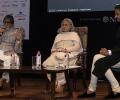
Amitabh: "There is a very famous limerick that aptly describes my presence tonight, ladies and gentleman: A funny young man from Clyde In a funeral carriage was spied; When asked, "Who is dead?" He giggled and said, "I don't know; I just came for the ride."

'From the beginning (I have told her) "Whatever it may be -- you are losing or winning -- on the ground you're not going to cry!" She never cried.' '"I don't want you to project that you are a loser. You are a winner".' Vaihayasi Pande Daniel/Rediff.com speaks to Leela Raj about her famous daughter, now in the West Indies for the women's T20 World Cup.
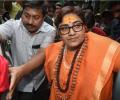
Pragya Singh Thakur remained at the back of the courtroom during Tuesday's framing of the charges, her face serene, quite different from the fiery person one read about or saw on television. But once the day's proceedings were over and she was wheeled out, the sadhvi decided she actually was very keen to meet the media and headed right out into the melee, says Vaihayasi Pande Daniel/Rediff.com.

Sanjeev Khanna stepped out of his usual sort of absent-minded personality to actively 'log into' the hearing, following the testimony alertly, at times standing up in the accused box to catch all of what was being said. His co-accused Peter Mukerjea and Indrani Mukerjea were less attentive, but were not switched off either.

Accused No 1 announced that there had been a change in the circumstances of her health condition. She produced a thick 19-page document, written in her neat, very feminine handwriting, detailing her condition, its symptoms and the consequences it could have on her health and well-being.

Ever since Indrani's bail plea was denied by the judge her security has been stepped up. The message was clear. If she felt that unsafe she could get all the security she needed. But in jail she stayed.

Devulkar had a certain abnormal vagueness about him that was unreal and defied belief. That came across in both his slightly too easy-going, extra-cooperative manner and the ragged nature of his testimony.

'I went to slums in India which were quite destitute, where people were clearly really struggling, but typically there is a sort of sense of purpose.' 'People are hustling.' 'What that tells you is that if the country was so organised in a way to give these people opportunity, then they would make something of it.'

'With folded hands, on humanitarian grounds, if she can get temporary bail on medical grounds so she can get treatment.' 'If she dies, the whole trial gets derailed.'

'Who is the right Mekhail? Mekhail I or Mekhail II?'

Mekhail hopped off the bench in a hurry and turning his back to Indrani, stood at the window. Indrani ignored him too. Mekhail is getting married later this year. His mother will, of course, not be in attendance. Nor, of course, would he want her to be there, if she could.

'The three tycoons I deal with in the first chapter -- Ambani, Mallya and Adani -- in their own way represent the change that has come over India.' 'Of the three of them, Mallya is the most fun. He was terrific.' 'And I don't say that because I tell the story in the book of his golden toilet.'

Pasbola wound up his cross examination, tabling a new narrative in the murder case. That Sheena Bora had been murdered not by her mother. But by her brother.

And then came the chief moment of Friday. If the courtroom had a soundtrack, Beethoven's 9th would be playing, providing a triumphant, dramatic prologue to the production of this last clip. A woman reporter was asking Mekhail about Sanjeev Khanna. He says clearly, without mincing words, emphatically: 'Never seen him. First time I am hearing his name.'

'If India maintains the Constitutional set-up that its founders envisaged -- which is that it is a parliamentary democracy, with a broadly speaking market economy, in which all people are equal as everyone votes, in which the rights of minorities are respected -- that will be a great thing.' 'Not just for India. But for humanity.'

Mekhail delivered the most deliberate heart-tugging line of the day: "If a son asks his mother for money is wrong, then tell me." At the back Indrani gave one of her most beaming smiles that was meant to convey the exact opposite. This was no mother happy that her son had said he turned to her when he needed money because she was his mother.
Vaihayasi Pande Daniel reports from the Sheena Bora murder trial.

'Most likely scenario is Modi comes back with either a much smaller majority and no majority at all and a coalition.' 'Very hard to imagine him doing better than he did last time.' 'He will then be a weaker prime minister,' the author of The Billionaire Raj tells Rediff.com's Vaihayasi Pande Daniel.

It is not often that Goswami's Nation-Wants-to-Know shows become material evidence in a murder trial no less. Nor was it something CBI Special Judge J C Jagdale was wildly enthused about. It had to be done because as he put it to CBI Special Public Prosecutor Kavita Patil caustically: "Your witnesses gave interviews to channels about a serious crime."

The question being silently telegraphed around the court room was: When did this happen? Wasn't this trial about Indrani murdering her daughter to prevent her from marrying Rahul Mukerjea, her husband Peter Mukerjea's son from his first marriage?
